
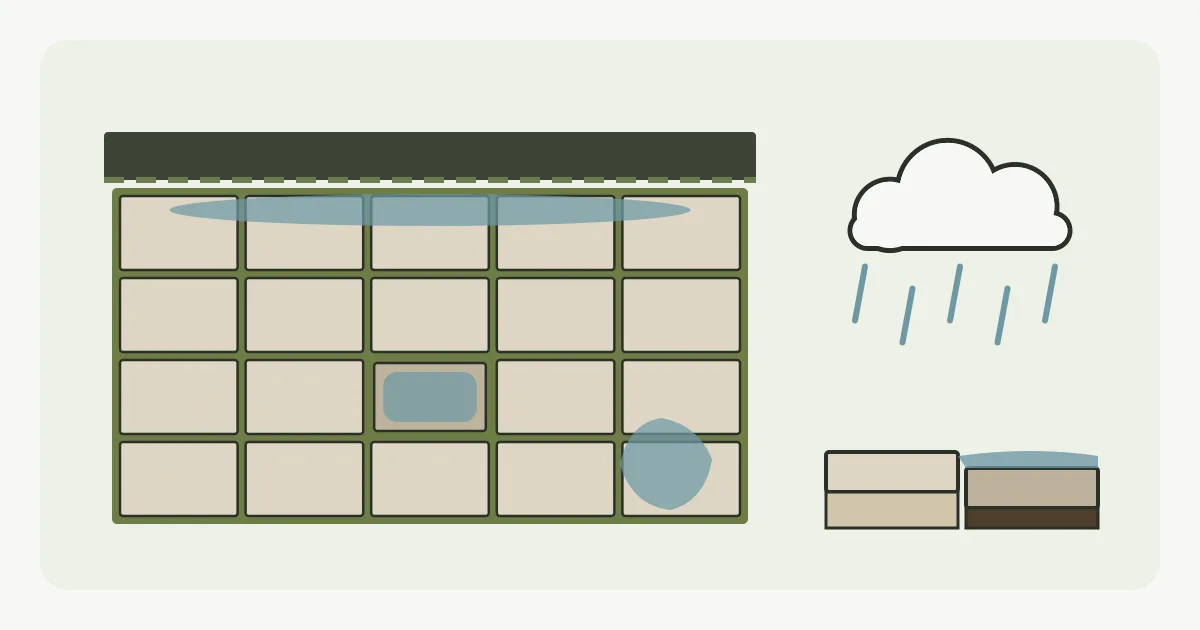
A puddle on a patio is a clue, and the most useful thing about it is where it sits. Water collects at the lowest point it can reach, so the place it ends up tells you whether the problem is the slope of the whole patio, one slab that has dropped, the joints, or simply that the water has nowhere to go once it's run off. Each of those has a different fix and a very different price.
Next time it rains properly, go out before anything dries and take a photo. Then find your puddle below.
Against the house wall
This is the one to deal with first. If water collects along the foot of the wall, the patio falls towards the house rather than away from it, or it's level and the wall is simply where the water stops. The result is a wall that gets wet every time it rains, and if the patio is also too close to the damp-proof course you may start to see damp patches or staining inside.
The cure is usually one of two things. The paving nearest the house is lifted and re-bedded with a proper fall away from the wall, or a channel drain is set along the wall to catch the water before it gets there. Often it's both. This is patio drainage installation work, and the patio drainage options comparison explains how a channel drain, a soakaway and permeable jointing differ.
Over one slab, roughly the slab's shape
A puddle with straight edges, sitting neatly over a single slab, nearly always means that slab has sunk. The bedding underneath has washed out or was never fully compacted, and the slab has dropped a few millimetres below its neighbours. Step on it: if it rocks or clicks, that confirms it.
This isn't really a drainage problem, and a channel drain won't fix it. The slab needs lifting, the bed under it rebuilding and the slab resetting level, which is a patio repair. One caveat. If several slabs in the same part of the patio have dropped, water is probably getting under the paving there, and repairing them one by one will only last so long.
Along the joint lines
Thin lines of water tracing the joints usually mean one of two things. The pointing has eroded below the slab surface, leaving a shallow channel that holds water, or the edges of neighbouring slabs aren't flush (installers call it lipping), so water is trapped against the higher edge. Eroded joints are a repointing job. Badly lipped slabs need re-bedding.
Joints that are packed with silt and moss can have the opposite effect on an open-jointed patio designed to drain through its joints: the water can't get down, so it sits on top. Cleaning them out may be all it needs.
A sheet of water across the whole surface
If the patio stays wet all over, with shallow water everywhere rather than one obvious puddle, it was very probably laid flat. There's no fall for the water to follow, so it just sits there until it evaporates. This is common on older patios and on cheaper jobs, and it's the expensive one to fix properly: the paving has to come up and be re-laid on a sub-base with the fall built in. On a small patio that can mean re-laying the lot. On a larger one it's sometimes possible to correct the worst section and add a channel drain to collect from it. Our guide to how a patio is laid explains where the fall should have gone in.
In a low corner or along the far edge
Here the patio is doing its job. The fall works and the water runs off, but then it gathers at the bottom with nowhere else to go. You see it most where a patio is boxed in by walls, raised beds or a lawn that sits higher than the paving, and on clay soil that won't soak it up.
The fix is somewhere for the water to discharge to: a channel drain or gully at the low point, piped to an existing drain or a soakaway. On heavy clay a soakaway can be slow or not work at all, so the installer may need to test the ground first. The patio drainage cost guide explains why the discharge point, rather than the drain itself, usually decides the price.
Quick reference
Where water collects, the usual cause and who fixes it. A guide only: some patios have more than one of these at once.
| Where the water sits | Likely cause | Usual fix |
|---|---|---|
| Along the house wall | Fall towards the house, or none | Re-lay with a fall, often plus a channel drain: patio drainage |
| Over one slab | Slab sunk; bed washed out | Lift, re-bed and reset: patio repairs |
| Along joints | Eroded pointing or lipped slabs | Repointing, or re-bedding the lipped slabs |
| Everywhere, thinly | Laid flat, no fall | Re-lay with the fall in the sub-base |
| Low corner or far edge | Nowhere for the water to go | Channel or gully to a drain or soakaway |
When it's something that changed
A patio that drained fine for years and has started holding water is worth thinking about differently. Ask what's changed nearby. A new lawn or raised bed built up against the edge can block the run-off. A gully clogged with leaves will back up. An extension or a neighbour's new paving can send more water your way than the patio was ever set up to shed. And a slab or two settling can be the first sign that water is getting underneath. The signs your patio needs work checklist is a good way to check for that.
Why it's worth fixing
- Damp. Water against the house wall, especially with paving close to the damp-proof course, can bridge into the brickwork.
- Slipperiness. Areas that stay wet grow algae and black spot first, and that's where people slip. Our guide to cleaning a patio without damaging it covers getting it off safely, but the growth comes back if the water does.
- Frost. Water sitting in joints and under slabs freezes, expands and pushes, which is how one sunken slab becomes three.
- The bed. Water that finds its way under the paving slowly washes out the bedding, so standing water now usually means repair bills later.
Any fix has to take the water somewhere it's allowed to go: a soakaway, an existing drain or a watercourse. Directing surface water onto a neighbour's property or the public highway isn't acceptable, and where new drainage goes in close to the house, Building Regulations Approved Document H can apply. A specialist should tell you where they plan to send it before work starts.
Frequently asked questions
Is standing water on a patio a problem?
A little water that clears within an hour or so of rain stopping is normal, especially on riven stone. Puddles that last for hours, sit against the house wall or come back in the same spot every time are worth investigating, because they usually point to a fall, a sunken slab or a drainage problem.
Can I drill holes in my patio to let the water out?
It rarely works. A hole through a slab only drains the water into the bed and sub-base underneath, which is exactly where you don't want it, and on clay the water has nowhere to go from there anyway. Fixing the fall or adding a drain at the low point is the reliable answer.
Will a channel drain stop water pooling on my patio?
Only if the water can reach it. A channel drain collects water that runs to it, so it works well at the foot of a correct fall or along a house wall. It won't drain a puddle sitting over a sunken slab in the middle of the patio.
What fall should a patio have?
A common target is around 1 in 80, roughly 12mm for every metre, with riven stone often laid a little steeper. The fall should run away from the house towards somewhere the water can safely go.
Ready to talk to a patio repairs specialist?
Get Free Quotes →