
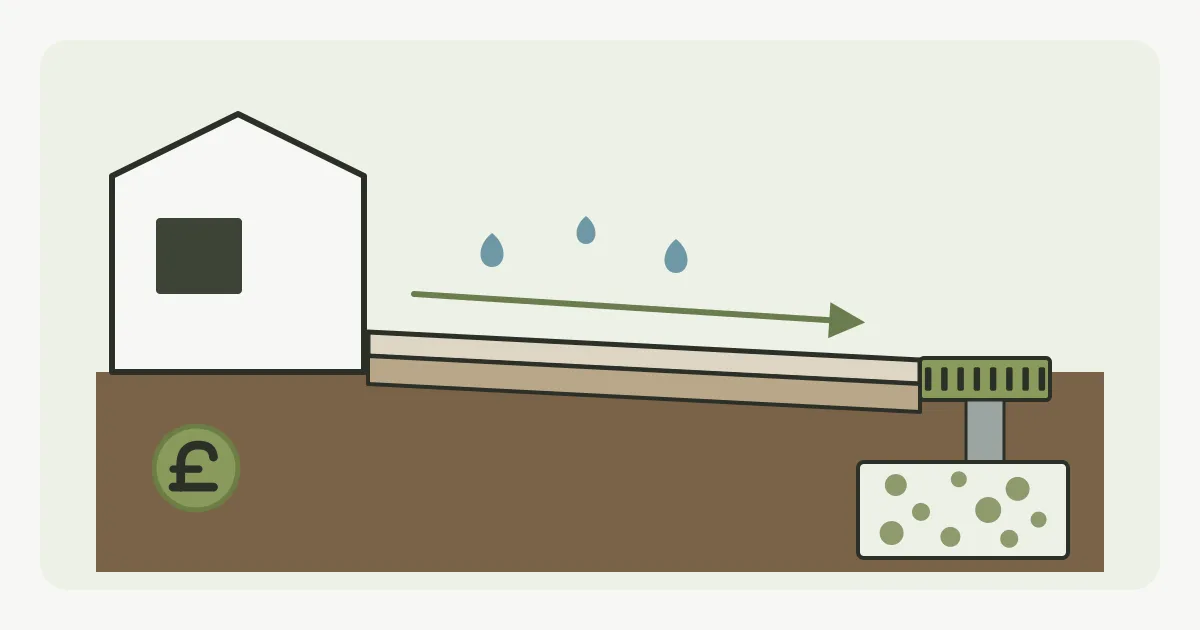
Patio drainage work in the UK typically costs between £400 and £1,500. It's the job homeowners think about last and should often think about first: water that has nowhere to go is what washes bedding out from under slabs, keeps joints permanently damp, and grows the algae that makes a patio slippery every winter. Fixing it is usually cheaper than repeatedly fixing what it damages.
Patio drainage cost by job type
These are typical prices for patio drainage installation, covering design, excavation, the drainage itself and reinstating any paving that had to be lifted.
Typical UK prices. Actual quotes vary by the length of channel or pipe run, ground conditions, access for digging and how much paving has to be lifted.
| Job type | What's usually involved | Typical cost |
|---|---|---|
| Short channel drain or localised fix | A run of channel drain at the low point or along the house edge, connected to an existing discharge | £400 – £700 |
| Re-laying falls across a patio section | Lifting an area of paving, correcting the fall underneath and re-bedding it so water clears properly | £700 – £1,100 |
| Full drainage system with soakaway | Channel and pipework plus a new soakaway excavated and built, for patios with no existing discharge point | £1,100 – £1,500+ |
The discharge point drives the price
The instinct is to price this job by how much water there is, or by how long a run of channel drain the patio needs. In practice neither is what decides the figure. What matters is where the water is allowed to end up.
A channel drain is a relatively inexpensive thing to fit. Connecting it to an existing, suitable drainage run a few metres away is straightforward. Having nowhere to connect it to is what pushes a job from the bottom of the range to the top, because then a soakaway has to be dug, built and sited properly — and that's a pit, excavated by hand or machine, filled with rubble or crate units, at a sensible distance from the house and from boundaries.
Ground conditions matter here more than anywhere else in this trade. A soakaway works by letting water disperse gradually into the surrounding soil, and it needs soil that will actually take it. On free-draining ground that's fine. On heavy clay it can be slow enough that a soakaway isn't the right answer at all, and a piped route to an existing system is specified instead. That's why two identical-looking patios in different parts of the country can get very different quotes.
Retrofitting costs more than building it in
If you're having a new patio laid, getting the falls right and putting any drainage in at the same time adds relatively little — the ground is already open, the paving isn't down yet and it's all one visit. Coming back to a finished patio to solve a water problem means lifting paving that's already been laid and paid for, working around what's there, and re-bedding it afterwards.
So if you're at the planning stage for a new patio installation, this is the cheapest moment you will ever have to deal with drainage. Planning a new patio covers where it fits in the sequence.
What else drives the cost
- Whether there's an existing discharge point, and how far away it is. Every metre of pipe run is a metre of trench.
- Ground conditions. Clay drains slowly and digs hard; both push the price up.
- How much paving has to be lifted and re-bedded, and whether it survives being lifted.
- Access for excavation. A back garden reachable only through the house means every barrow of spoil comes out the same way.
- The type and load rating of the channel and grate. A patio grate is a lighter specification than one a car will drive over, and priced accordingly.
- Whether slabs damaged by the original water problem need putting right at the same time — see the patio repair cost guide.
Surface water shouldn't be directed onto a public highway or a neighbour's property. Any channel drain or soakaway needs to discharge to a soakaway, an existing drainage run or a watercourse. Where new drainage goes in close to the building, Building Regulations Part H can be relevant — particularly around keeping paving falls and new drainage clear of the damp-proof course and the foundations. The approved document is published on gov.uk, and a specialist should be able to confirm whether it applies to your job.
Is drainage the job you actually need?
Standing water isn't always a drainage problem. Sometimes it's one sunken slab creating a dip, which is a patio repair; sometimes it's joints so blocked with silt and moss that water can't get away, which shades into repointing. Our guide on whether to repair, repoint or replace your patio walks through how to tell them apart, and the signs your patio needs work checklist covers what to look for after heavy rain. For a rough figure, try the patio cost calculator.
Frequently asked questions
Why is water pooling on my patio?
Usually because the surface has no fall, or not enough of one, so water has nowhere to run to. The other common causes are a slab that has sunk and created a dip, joints blocked with silt and moss so water can't drain away, or a change elsewhere in the garden — new landscaping, a raised bed, a re-laid lawn — that has altered where water goes.
What's the difference between a channel drain and a soakaway?
A channel drain collects surface water running across the patio and carries it away through a pipe. A soakaway is where that water is ultimately allowed to disperse into the ground. Many systems use both together, which is why a quote can list both.
Can I fix patio drainage without relaying the whole patio?
Often yes, particularly if the problem is localised — a channel drain or soakaway added at the right point can solve it without disturbing paving elsewhere. Widespread pooling across the whole surface usually points to a falls problem instead, and that needs the affected area lifting and re-laying to fix properly.
Does a patio need planning permission if drainage is added?
Routine drainage work to an existing garden patio doesn't usually need planning permission in itself. What does matter is where the water discharges, and Building Regulations Part H can apply where new drainage goes in near the building. If you're unsure, a quick check with your local authority will confirm it before work starts.
Ready to talk to a patio drainage installation specialist?
Get Free Quotes →