
What Is Patio Drainage Installation?
Patio drainage installation is the work of fitting channel drains, soakaways or correct surface falls so that rainwater is carried away from a patio rather than pooling on it or running towards the house. It's typically needed when a patio was laid without enough attention to falls in the first place, or when ground conditions or a change in the surrounding landscaping mean water no longer clears the way it used to.
It's easy to overlook until standing water becomes a regular problem, but getting the drainage right is one of the most important parts of any patio build — a beautiful surface that holds water after every shower is both a nuisance and, over time, a real risk to the paving and the property behind it.
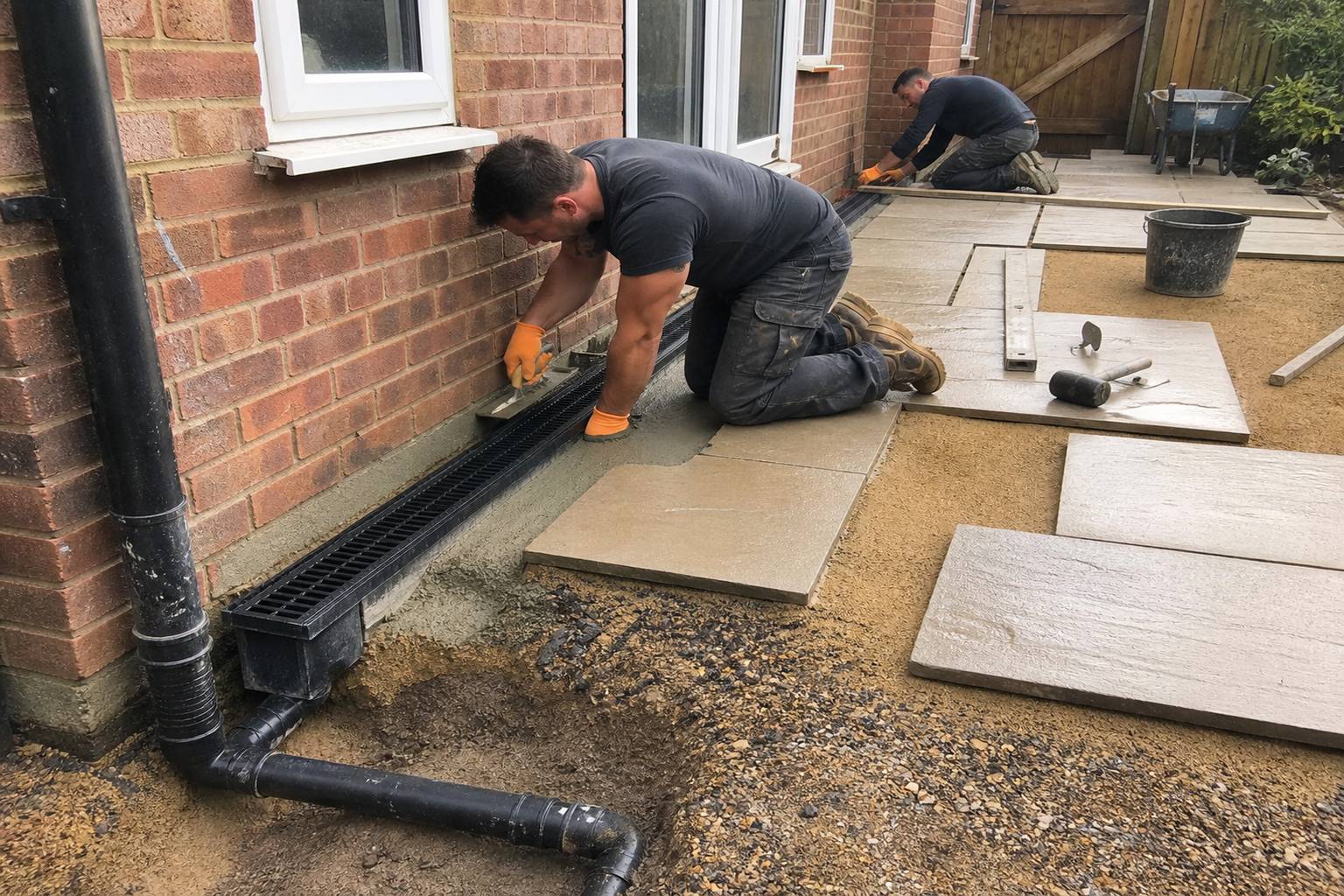
Signs You Need Patio Drainage Installation
- Puddles that sit on the patio for hours (or days) after rain instead of clearing
- Water visibly running towards the house rather than away from it
- Damp patches or staining appearing on a nearby wall or damp-proof course
- A patio that feels slippery or grows algae in patches where water regularly collects
- Water pooling at low points or along one edge of an otherwise flat, sound patio
If the patio itself is cracked, sunken or damaged as well as holding water, it's worth also looking at patio repairs — poor drainage and slab damage often go hand in hand, since standing water is a common cause of the sub-base washing out underneath. Our signs your patio needs work checklist explains how to tell a drainage problem from a paving one, and repair, repoint or replace? covers which to fix first.
Patio Drainage Methods Explained
The right approach depends on how much water needs to be moved and where it can go:
- Correcting the falls — the simplest fix where the paving is otherwise sound: slabs are lifted and re-bedded to a proper gradient, typically around 1:80, so water sheets off the surface towards a safe point rather than sitting on it or running towards the house.
- Channel or linear drains — a slotted drainage channel is set into the paving, usually along the edge nearest the house or at the lowest point of the patio, collecting surface water and carrying it away via a pipe to a soakaway or existing drainage run.
- Soakaways — a below-ground pit filled with rubble or a purpose-made crate system, giving collected water somewhere to disperse gradually into the surrounding soil rather than being piped to a sewer.
- Permeable jointing — an open-jointed laying system using permeable aggregate or resin jointing that lets rainwater filter down through the paving itself into a free-draining sub-base, reducing surface run-off in the first place.
Most jobs combine two or more of these — for example, correcting the falls across the patio and adding a channel drain at the point closest to the house — rather than relying on a single fix.
What to Include When Asking for a Quote
Sketch out the rough size and shape of the space, describe what's there at the moment, and say what you want the finished patio for — everyday dining, an occasional table, or space for a hot tub, since load-bearing needs change the specification. Mention nearby drains, changes in level, or anything overhead, so the quotes you get back are pricing the same job.
For patio drainage installation, ask for the finished level written down against the damp-proof course and any doorways, and where surface water will run to. If a new patio is going in at the same time, our guide to planning a new patio covers both those levels — it's far cheaper to design the fall and the drainage in now than to retrofit either later. The written breakdown should separate excavation, base, drainage connections and paving, so it's clear what each stage covers and what happens to the arisings.
When you're weighing up more than one quote, make sure each one actually breaks down excavation, sub-base, paving material, edging and drainage rather than just quoting a price per square metre — that's the only way to see what's really different between them. Ask specifically whether spoil removal, permits and reinstating the surrounding area are included, since a lower headline price sometimes just means less is covered.
How Much Does Patio Drainage Installation Cost?
| Job type | Typical cost |
|---|---|
| Short channel drain / localised fix | £400 – £700 |
| Re-laying falls across a patio section | £700 – £1,100 |
| Full drainage system with soakaway | £1,100 – £1,500+ |
These are indicative UK averages rather than a quote — the length of channel or pipe run needed, ground conditions, access for digging and whether existing paving has to be lifted and re-laid all affect the final price. Get a free, no-obligation quote from a local specialist for a figure based on your own patio.
Our patio drainage cost guide explains why the discharge point drives the price more than the drain itself does, and why retrofitting costs more than building drainage in from the start. For a quick ballpark, use the patio cost calculator.
The Patio Drainage Installation Process: What to Expect
- Assessment. The specialist checks where water is coming from, where it's pooling, and where it can realistically be taken to.
- Design. A drainage route is planned — whether that's re-graded falls, a channel drain, a soakaway, or a combination — along with where the water will ultimately discharge.
- Excavation. Trenches are dug for channels or pipework, and a soakaway pit is excavated if one is needed.
- Installing drainage. Channel drains, pipework and any soakaway are fitted and connected, and paving is lifted and re-bedded to the correct falls where required.
- Reinstatement and testing. Slabs are reset and pointed, the area is cleaned down, and the system is tested with water to confirm it clears properly.
Planning Permission and Building Regulations
In most cases, no planning permission is required on its own, since it's usually treated as routine work to an existing garden feature rather than a new structure. What does matter is where the water ends up — surface water shouldn't be directed onto a public highway or a neighbour's property, so any channel drain or soakaway needs to discharge to a soakaway, existing drainage or a watercourse rather than simply running off the boundary. Where the scale of the work involves altering how water is managed close to the building, Building Regulations Part H (drainage and waste disposal) can be relevant, particularly around keeping paving falls and any new drainage clear of damp-proof courses and building foundations — a specialist should be able to confirm whether it applies to your job, and it's worth a quick check with your local authority if you're at all unsure.
How to Choose a Patio Drainage Specialist
- Ask them to explain where the water is coming from and where it will be taken to before any work starts
- Check whether a soakaway is needed and, if so, where it will be sited and how it will be sized
- Confirm how the finished falls will be checked and tested before they sign the job off
- Ask whether existing paving needs to be lifted and relaid, and how that's reflected in the price
- Get at least two quotes, since drainage solutions and pricing can vary quite widely between specialists
Frequently Asked Questions
Why is water pooling on my patio?
Pooling almost always comes down to insufficient fall across the paving, a low spot that's settled over time, or drainage that was never properly designed in when the patio was first laid — a specialist can usually tell which by checking the levels.
What's the difference between a channel drain and a soakaway?
A channel drain collects surface water running across the patio and carries it away through a pipe, while a soakaway is where that water is ultimately allowed to disperse into the ground — many systems use both together.
Can I fix patio drainage without relaying the whole patio?
Often yes, particularly if the problem is localised — a channel drain or soakaway added at the right point can solve the issue without disturbing paving elsewhere, though widespread pooling usually points to a falls problem that needs re-laying to fix properly.
How much does patio drainage installation cost on average?
Most UK patio drainage installation jobs cost between £400 and £1,500, depending on the type of system needed and how much existing paving has to be lifted. Get a free quote for a price based on your own patio.