
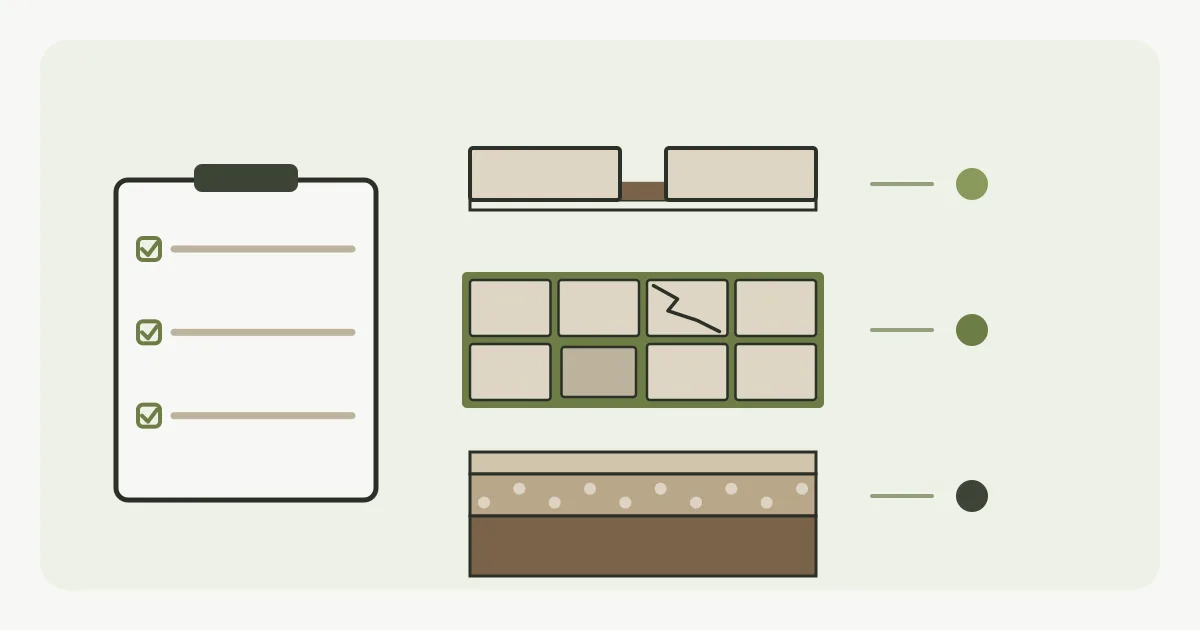
Almost every patio problem shows up on the surface, and almost none of them start there. That's the difficulty with judging a patio by how it looks: crumbling joints, a rocking slab and a puddle that never clears can all present themselves at roughly the same time, and they're three different jobs at three very different prices.
So it's worth checking a patio in layers rather than in a sweep — the joints first, then the slabs, then what's underneath them. Work down through the three lists below and note which layer your ticks fall in. That's what tells you which job you're actually looking at.
Layer one: the joints
The material between the slabs is the first thing on any patio to fail, because it's the thinnest, the most exposed and the part water attacks first. Good news, generally: it's also the cheapest to put right.
- Pointing that crumbles when you run a key or screwdriver along it, rather than resisting.
- Gaps opening up between slabs where the mortar has washed out entirely, leaving the bedding visible below.
- Weeds or grass growing through the joints faster than you can keep on top of them — a sign there's now soil in there for them to root in.
- Moss filling the joints, particularly on the shaded side of the patio.
- Loose grit or sand appearing on the surface after rain, washed up out of the joints.
- Joint material that has cracked away cleanly from the slab edge on one side, which usually means movement rather than wear.
Ticks confined to this layer point to patio repointing — typically £300 to £1,200, covered in the patio repointing cost guide. A patio with sound, level slabs and failed joints looks far worse than it is.
Layer two: the slabs
Check this layer with your feet, not your eyes. Walk every slab in turn and put real weight on it, heel to toe. A slab that moves underfoot often looks no different from one that doesn't, and it's movement rather than appearance that matters.
- A slab that rocks, clicks or gives slightly when you step on one corner.
- Cracks running right through a slab, as opposed to surface crazing on concrete flags.
- Chipped or broken edges and corners, especially along walking routes and at steps.
- A slab sitting proud of or below its neighbours, creating a lip you can catch a toe on.
- Slabs that sound hollow when tapped — the bed beneath has voided even if the slab hasn't dropped yet.
- Staining or spalling that goes into the slab rather than sitting on it, which is more common on unsealed natural stone.
Ticks here mean patio repairs, typically £150 to £600 — see the patio repair cost guide. Worth batching them: much of the cost of a small repair is the visit rather than the work, so doing three slabs at once costs far less than three separate call-outs.
Layer three: the bed and the ground underneath
This is the layer you can't see, so you read it from the pattern of what's happening above it. These signs matter more than the two lists above, because nothing done to the joints or the slabs will hold if this layer is the problem.
- Water standing on the surface twenty minutes after rain has stopped, rather than clearing away.
- A dip or hollow you can see when you crouch down and look across the patio at eye level.
- Slabs that have been re-bedded before and have sunk again.
- Several slabs going the same way in the same area — along the house, near a downpipe, or at the lowest corner.
- Algae that comes back in the same patches every winter, which marks where water sits.
- Joint material washing out repeatedly in one spot after being renewed.
- The patio surface visibly sloping towards the house rather than away from it.
Ticks in this layer usually mean water, and water means patio drainage — typically £400 to £1,500, set out in the patio drainage cost guide. If the whole patio is affected rather than one area, the sub-base itself may be failing, in which case a new patio installation is the realistic answer.
Reading your ticks
Where your ticks cluster is a better guide than how many you have.
| Where the ticks are | What it usually means | Typical cost |
|---|---|---|
| Layer one only | Joints worn out on an otherwise sound patio — repointing | £300 – £1,200 |
| Layer two only, a few slabs | Localised damage — repairs | £150 – £600 |
| Layer three, in one area | Water isn't clearing — drainage first, paving second | £400 – £1,500 |
| All three layers, across most of the patio | The build-up beneath has failed — a new patio | £1,500 – £5,000 |
If the patio slopes towards the house rather than away from it, or the finished surface sits close to the damp-proof course, get that looked at regardless of what else is on your list. Water directed at the wall is a problem for the building, not just the patio, and it's the one thing on this page that's worth acting on before the rest.
What to do next
Take the proportions with you rather than just the list — roughly how many slabs and how much of the jointing. That's what decides between the routes, and our guide on whether to repair, repoint or replace your patio walks through where the lines fall. For a rough figure on any of them, the patio cost calculator will give you a starting point before you get quotes.
Frequently asked questions
How do I know if my patio needs replacing or just repairing?
It comes down to how much has failed rather than how bad it looks. If most of the surface is still flat and stable, repairs or a repoint will do. Once damage has spread across more than about half the patio, or the same slabs keep sinking after being re-bedded, replacement is generally the better value.
Is a wobbling patio slab serious?
It's worth dealing with promptly. A slab that rocks is a trip hazard, and the movement gradually works the joints around it loose, so one rocking slab tends to become three. The underlying cause is usually washed-out or poorly compacted bedding, which is a straightforward fix while it's confined to one or two slabs.
How long should a patio last?
A properly built patio on a sound sub-base typically lasts twenty years or more, and natural stone often longer. The joints are the part that won't — pointing generally needs renewing every ten years or so, sooner on a patio that holds water or gets heavy use.
Does moss on a patio mean there's a problem?
Not on its own — moss grows readily on any shaded, damp UK paving and is mostly cosmetic. What's worth noting is where it grows. Moss appearing in the same patches every winter, particularly in the middle of an otherwise clear patio, usually marks where water is sitting, and that's a drainage signal rather than a cleaning one.
Ready to talk to a patio repointing specialist?
Get Free Quotes →