
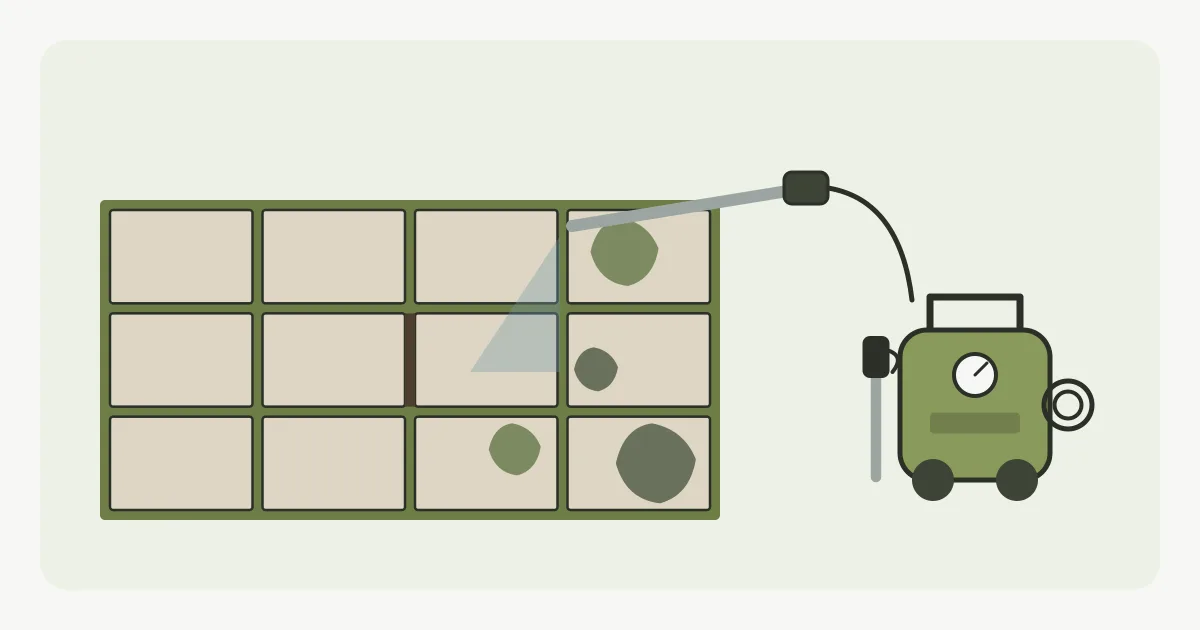
The most common way to damage a patio isn't frost or tree roots. It's cleaning it. A pressure washer held close to the surface and swept along the joints will strip out the pointing or jointing sand in an afternoon, and on soft stone it can scour the surface itself. What started as a cleaning job becomes a repointing job.
So the rule for cleaning a patio is to start with the gentlest thing that might work and only step up if it doesn't. Before any of that, though, work out what you're cleaning and what's growing on it.
Know the surface first
General guidance by paving type. Always check the manufacturer's or supplier's care advice for your specific paving.
| Paving | Generally safe | Be careful with |
|---|---|---|
| Porcelain | Brushing, mild detergents, pressure washing at a sensible distance | Little. The surface is very hard and non-porous; the joints are the weak point |
| Indian sandstone | Brushing, biocide treatments, gentle pressure washing | Close-range pressure washing, which can scour the surface; acid cleaners, which can discolour some sandstones |
| Limestone | Brushing, pH-neutral cleaners, biocides | Acid of any kind, which attacks the stone itself |
| Concrete flags | Most methods, including pressure washing | Strong acids, which etch the surface and expose the aggregate |
| Any patio with sanded joints | Brushing and biocides | Pressure washing near the joints, which empties them |
Know what's growing on it
- Green algae. A slimy green film, worst in shade and wherever water sits. It's the main reason patios get slippery. It comes off fairly easily but returns quickly if the patio stays damp.
- Moss. Cushions in the joints and on the shady edges. It holds water against the stone and roots into weak pointing.
- Black spot. Small, flat, black dots that look like paint spatters, very common on Indian sandstone. These are lichens, and they're rooted into the stone surface. Scrubbing and pressure washing usually leave them behind. They respond to biocide treatments applied and left over a period of weeks, and even then they fade rather than vanish.
- Weeds in the joints. These root down into the joint from seeds blown on top, so they're a sign the joints have eroded or were never fully filled.
- White powdery bloom on a newish patio. Usually efflorescence, salts working out of the mortar or stone. It looks alarming, isn't growth, and generally weathers away on its own. Washing it with acid can make things worse.
The gentle-first ladder
Work up these steps and stop at the first one that does the job.
- Sweep and scrub. A stiff broom, water and a little mild detergent shifts surface dirt and fresh algae. Dig moss out of the joints with a joint scraper or old knife rather than blasting it.
- Treat with a biocide. Patio and path biocides kill algae, moss and, slowly, black spot. Some are rinsed off after a short time; others are left on for rain to work in over weeks. They do the work gradually, which is the trade-off for not damaging anything.
- Pressure wash, carefully. Use a fan nozzle rather than a rotating 'turbo' nozzle, keep the lance at a shallow angle and a sensible distance, and work across the slabs, not along the joints. A rotary surface-cleaner attachment, the round hood that spins the jet under a cover, is gentler and more even on large areas.
- Specialist cleaners. Stubborn stains, mortar residue or rust marks may need a dedicated product. This is where you can do real harm, particularly with acid-based cleaners on limestone and some sandstones, so test a hidden corner first and follow the label exactly.
The patio cleaners and sealers comparison explains the main product types, what each is for and which surfaces they suit.
Using a pressure washer without wrecking the joints
Pressure washers are brilliant on porcelain and concrete and risky everywhere else, mainly because of the joints. Mortar pointing that's already a bit tired will crumble under a close jet, and brush-in jointing sand simply washes away. Once the joints are open, water gets under the slabs, weeds have somewhere to root and the slabs can start to move.
- Test on a hidden area first and look closely at the joint afterwards.
- Keep the lance moving and at a shallow angle; never hold it still over one spot.
- Sweep across slabs rather than tracing the joint lines.
- On sandstone, stand further back than feels effective. A scoured surface is more porous and goes green again faster.
- Expect to re-fill some joints afterwards, even if you've been careful.
If the joints were already crumbling before you started, cleaning will expose it rather than cause it. The fix is the same: patio repointing, and the patio repointing cost guide gives typical prices. Cracked or loose slabs uncovered by cleaning are a patio repair.
Safety with cleaning products
- Read the label and follow it. Products that kill algae and moss are regulated, and the label sets out how they may legally be used. The Health and Safety Executive's biocides pages explain the regime.
- Never mix products. Bleach-based cleaners mixed with acid-based ones can release chlorine gas.
- Keep run-off away from ponds, drains that lead to watercourses, and plants you want to keep.
- Wear gloves and eye protection, and keep children and pets off the area until it's rinsed or dry as the label directs.
Stopping it coming back
Algae and moss grow where patios stay wet and shaded. Cleaning removes them; it doesn't change the conditions. If the same areas go green every winter, look at why water is sitting there. Our guide to water pooling on a patio covers the usual causes, and patio drainage is often the long-term fix. On natural stone, a sealer can slow regrowth and make future cleaning easier, though it has trade-offs; patio sealing explained goes through when it's worth it.
If you're asking for repointing or repair quotes, give the patio a gentle clean first, or at least send photos of a cleaned patch. Moss and grime hide the state of the joints, and a contractor pricing blind will either guess high or find surprises on the day.
How to clean a patio safely
- Identify the paving and the growth
Check whether the patio is porcelain, sandstone, limestone or concrete, and whether you're dealing with algae, moss, black spot or stains.
- Sweep and scrub
Clear debris, scrub with a stiff broom, water and mild detergent, and scrape moss out of the joints by hand.
- Apply a biocide if needed
For algae, moss or black spot, apply a suitable patio biocide exactly as the label directs, and give it the time it needs to work.
- Pressure wash only if necessary
Test a hidden area, use a fan nozzle at a shallow angle and a safe distance, and work across the slabs rather than along the joints.
- Check and refill the joints
Once dry, look for emptied or crumbling joints and refill or arrange repointing before water gets under the slabs.
Frequently asked questions
Will pressure washing damage my patio?
It can. The usual damage is to the joints: tired mortar crumbles and jointing sand washes out. On softer stone like sandstone, a close jet can also scour the surface. Used at a shallow angle, a sensible distance and across the slabs rather than along the joints, a pressure washer is much less risky, especially on porcelain and concrete.
How do I get rid of black spot on a sandstone patio?
Black spot is lichen rooted into the stone surface, so scrubbing and pressure washing rarely shift it. A biocide treatment designed for it, applied and left to work over several weeks, usually fades it. Some marks may remain, and it can return if the patio stays damp and shaded.
Can I use bleach to clean my patio?
Diluted bleach-based cleaners are used on some patios, but they can discolour certain stones and harm plants, lawns and ponds nearby. Never mix them with acid-based cleaners. A purpose-made patio cleaner or biocide used as directed is usually the safer choice.
How often should a patio be cleaned?
A sweep and occasional scrub through the year keeps most patios in good order, with a fuller clean once a year, often in spring. Shady, damp patios may need biocide treatment more often, and that's usually a sign drainage or fall is worth checking.
Ready to talk to a patio repointing specialist?
Get Free Quotes →