
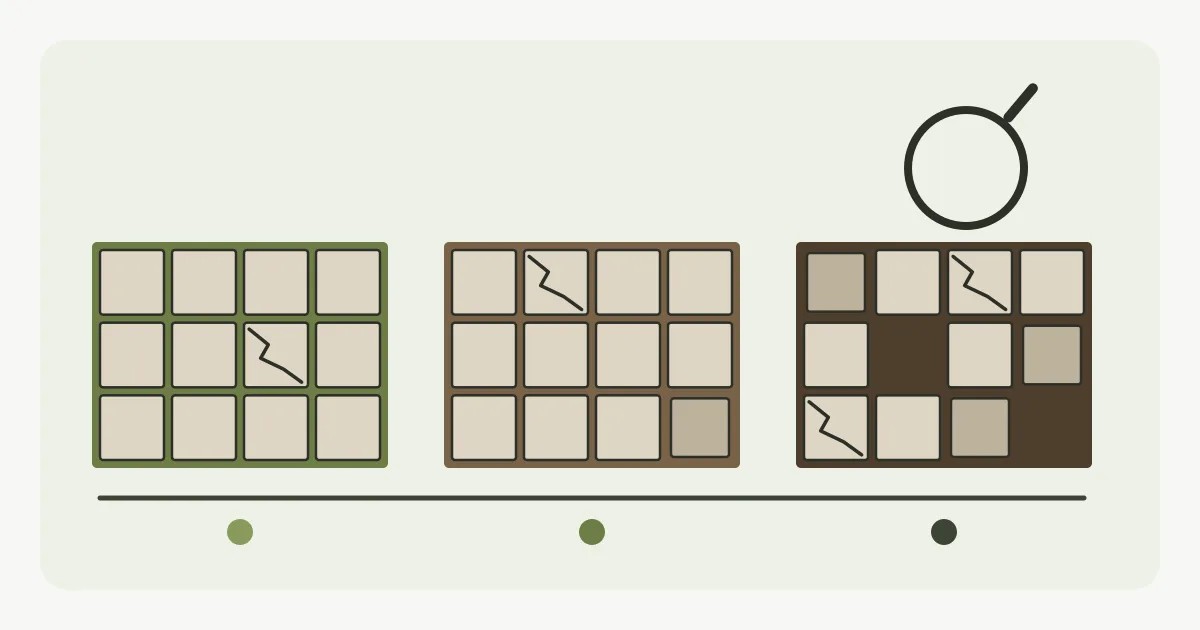
A tired patio gets one of three answers: fix the bits that have failed, renew all the joints, or take it up and start again. Most people try to decide by standing at the back door and looking, and looking is exactly what makes this decision hard — a patio with mossy joints and a couple of cracked slabs looks finished when it usually isn't.
There's a more reliable way to get to the answer, and it takes about ten minutes with no tools. You count.
Start by counting, not by looking
Go out to the patio and work out two proportions. First, roughly what share of the slabs are cracked, chipped, rocking or sitting visibly low — walk across every one and put your weight on it rather than judging by eye, because a slab that rocks doesn't always look any different from one that doesn't. Second, roughly what share of the joints have failed: crumbled, washed out, or gone soft and full of moss.
You want two rough percentages, not exact figures. "About one in ten slabs, but nearly all the joints" is precise enough to make the decision, and it's the combination of the two numbers that points to the answer.
Under a quarter affected: repair, or repoint
If only a handful of slabs are damaged and the rest of the surface is flat and stable, you're looking at patio repairs — lifting the affected slabs, topping up and re-compacting the bedding underneath, and resetting them level. Typically £150 to £600 depending on how many, and worth batching together in one visit because much of that cost is the visit itself. The patio repair cost guide covers how that breaks down.
If the slabs are fine but the joints have gone across most of the patio, that's a different job with a similar answer: patio repointing, typically £300 to £1,200. This is the case people most often get wrong, because failed pointing is what makes a patio look past it. A patio with sound, level slabs and crumbling joints is not a patio that needs replacing — it's one that needs the cheapest job on this list. See the patio repointing cost guide.
A quarter to a half: repoint now, and start budgeting
This is the genuinely awkward middle, and the honest answer is that both routes are defensible.
Repairing and repointing will work, and on a patio you're happy with it's good value — you'll likely get another five to ten years. What you should do at the same time is work out why this much has failed. A patio that's simply old fails gradually and evenly. A patio where a quarter has gone in a few years usually has a reason underneath it, and if you don't find the reason you'll be back here sooner than the cost implies.
Replacing makes more sense at this end if you were already unhappy with the patio's size, layout or material, or if the slabs are a discontinued range and matching replacements can't be found. Paying to repair a surface you don't much like is how people end up spending twice.
More than half: replacing is usually cheaper than chasing it
Once damage has spread across most of the surface, repairs stop paying. You're re-bedding slabs next to slabs that are about to go the same way, pointing around paving with years left in it at best, and paying the fixed cost of a visit each time. A repair only really pays off when most of the existing surface is still in good condition — past that point a full patio installation is the better value even though the headline number is higher.
Widespread failure is also a signal in its own right. Slabs across the whole patio going at once usually means the sub-base underneath was never right, or has been washed out. Nothing laid on top of that base will hold, which is why patching a patio in this condition tends to fail in new places every year.
When the count is the wrong question
Three situations override the proportions entirely.
- The failures are clustered, not scattered. Five bad slabs spread evenly across a patio is wear. Five bad slabs all in the same corner, or all in a line along the house, is a cause — almost always water. Re-bedding those slabs without dealing with it just resets the clock. That's a case for looking at patio drainage first and the paving second.
- The slabs can't be matched. Paving ranges get discontinued, and a patio laid fifteen years ago may be in a size, colour or texture that's no longer made. If a repair means visibly mismatched slabs in the middle of the patio, the economics shift towards replacement earlier than the count alone would suggest.
- You want something different anyway. If the patio is too small for a table, in the wrong part of the garden or in a material you've never liked, repairing it well is still money spent on keeping something you don't want. Planning a new patio is the better place to start.
What each route costs
Typical UK price ranges for each route. Figures are indicative rather than quotes.
| Route | When it's the right call | Typical cost |
|---|---|---|
| Repairs | A handful of cracked, rocking or sunken slabs on an otherwise sound surface | £150 – £600 |
| Repointing | Slabs sound and level, joints failed across most of the patio | £300 – £1,200 |
| Drainage | Failures clustered where water sits, or standing water after every downpour | £400 – £1,500 |
| New patio | More than half affected, base failing, or the patio is wrong for the garden | £1,500 – £5,000 |
If you land in the middle band, ask contractors to price both the repair-and-repoint route and the replacement. It costs nothing extra to ask, and seeing the two figures side by side for your actual patio is far more useful than any general range — including the ones on this page.
If you'd rather work through the symptoms first, the signs your patio needs work checklist goes layer by layer through what to look for. For a rough figure on any of the four routes, try the patio cost calculator.
How to work out what your patio needs
- Clear and sweep the surface
Move furniture and pots off the patio and brush it down. Leaves and grit hide exactly the things you're looking for, and a pot in the same place for three years is often sitting on the worst slab.
- Walk every slab and put your weight on it
Step firmly on each slab in turn, heel to toe. Anything that rocks, clicks or gives slightly underfoot goes on the list even if it looks perfect. Count them as a rough share of the total.
- Check the joints across the whole patio
Run a screwdriver or key along the pointing in several places. Sound pointing resists; failed pointing crumbles or is already missing. Estimate roughly what share of the joints have gone.
- Look at where the failures are, not just how many
Mark them on a rough sketch of the patio. Scattered evenly means general wear. Clustered in one area, along the house, or near a downpipe means a cause — usually water — that needs dealing with first.
- Go back out after heavy rain
Wait for a proper downpour and look again twenty minutes after it stops. Water still sitting on the surface tells you the falls or the drainage aren't working, whatever condition the slabs are in.
- Measure the area
Pace or measure the longest and widest points and multiply them. You need this for any quote, and it tells you which cost band you're in.
- Get quotes for the two nearest options
Once you know your proportions, ask two or three contractors to price both the cheaper route and the more thorough one. Comparing the two on your own patio is what actually settles it.
Frequently asked questions
Is it worth repairing an old patio or should I just replace it?
As a rule of thumb, repair while most of the surface is still sound and replace once more than about half has failed. The cost gap is wide enough — typically £150 to £600 for repairs against £1,500 to £5,000 for a new patio — that repairing is usually worth doing first unless the base itself is failing or you want a different patio anyway.
Can you lay a new patio over an old one?
Sometimes, but it's less often a good idea than it sounds. It only works where the existing surface is sound, stable and drains properly, and where raising the finished level still leaves the patio well below the damp-proof course. If the old patio is failing, laying over it puts new paving on an unreliable base and tends to buy a few years rather than solve the problem.
How do I know if the problem is the base rather than the slabs?
Two signs point that way: slabs failing across the whole patio at roughly the same time rather than one at a time, and slabs that sink again after being re-bedded. Both suggest the material underneath isn't supporting the paving, and nothing laid on top will hold until that's dealt with.
Should I fix the drainage before or after the paving?
Before, where drainage is the cause. Water that has nowhere to go is what washes bedding out from under slabs and keeps joints permanently damp, so re-bedding slabs or repointing joints without fixing it means paying for the same work again. If a new patio is going in, getting the falls and any drainage right at that stage is far cheaper than retrofitting later.
Ready to talk to a patio installation specialist?
Get Free Quotes →