
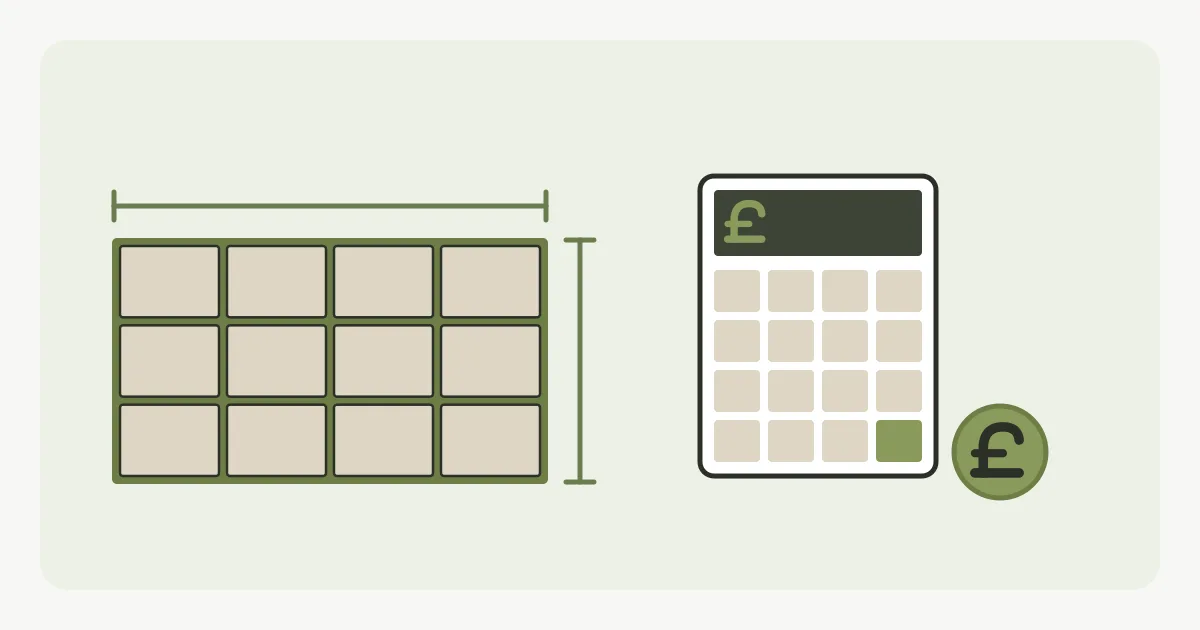
Choose the type of patio work and roughly how big the job is, and the calculator above returns a ballpark figure based on the typical UK price range for that service. It's a budgeting starting point rather than a quote — the only way to get a real number for your garden is a free, no-obligation visit from a local paving contractor.
What the estimate covers
Each range is the installed price for the work itself, so for the three installation options that means excavation, sub-base, laying, jointing and finishing rather than the cost of the slabs on their own. Job size is split three ways for every service, which for a new patio installation means roughly under 15m², 15 to 30m², and over 30m².
If you don't know your area yet, measure the longest and widest points of the space you have in mind and multiply them. It doesn't need to be precise — you're choosing which of three bands you're in, not pricing per slab.
What it doesn't account for
- Access. A back garden with no side gate can add a day of carrying materials through the house, and the calculator has no way of knowing that.
- Ground conditions. Soft, wet or made-up ground needs a deeper sub-base before anything is laid on it.
- Regional variation. Labour rates differ across the UK, and so does the cost of getting spoil away.
- Level changes, steps and curves. A sloping garden or a shaped edge costs more than the same area laid flat and square.
- The specific paving range. Within porcelain or Indian sandstone there's a wide spread between volume products and premium grades.
Turning an estimate into a quote
Use the figure to sense-check quotes rather than to replace them. If a quote comes in well under the band, that's usually a sign something is excluded — spoil removal and sealing are the two items most often left out. If it comes in well over, ask which part of the job is driving it; there's normally a specific reason, like a retaining edge or a drainage run, and it should be itemised.
The individual cost guides go into what sits behind each range: the patio installation cost guide, the porcelain patio cost guide, the Indian sandstone patio cost guide, the patio repointing cost guide, the patio repair cost guide and the patio drainage cost guide. If you're not yet sure which job you need, start with whether to repair, repoint or replace your patio.
Frequently asked questions
Is this calculator's estimate a real quote?
No. It's a ballpark figure built from typical UK price ranges for each service. A free, no-obligation visit from a local paving contractor is the only way to get an accurate price for your own garden, because access, ground conditions and level changes all move the number and none of them can be judged remotely.
Why are the installation ranges so much wider than the repair ones?
Because installation jobs vary far more. A repair is a bounded piece of work on an existing surface, while a new patio can mean anything from paving a flat 10m² corner to excavating a sloping 40m² garden, removing several tonnes of spoil and designing in drainage.
Does the estimate include VAT?
UK paving contractors generally quote domestic work inclusive of VAT, but smaller traders operating below the VAT threshold won't charge it at all. It's worth confirming explicitly when you compare quotes, since two prices aren't comparable if one includes it and the other doesn't.
Should I budget extra on top of the estimate?
It's sensible to keep a contingency of around ten per cent for a new patio, mainly because what's under the ground isn't known until it's opened up. Old concrete bases, buried rubble and soft spots are common and all add excavation and spoil removal. Repair and repointing jobs carry far less of this risk.
Ready to talk to a patio installation specialist?
Get Free Quotes →