
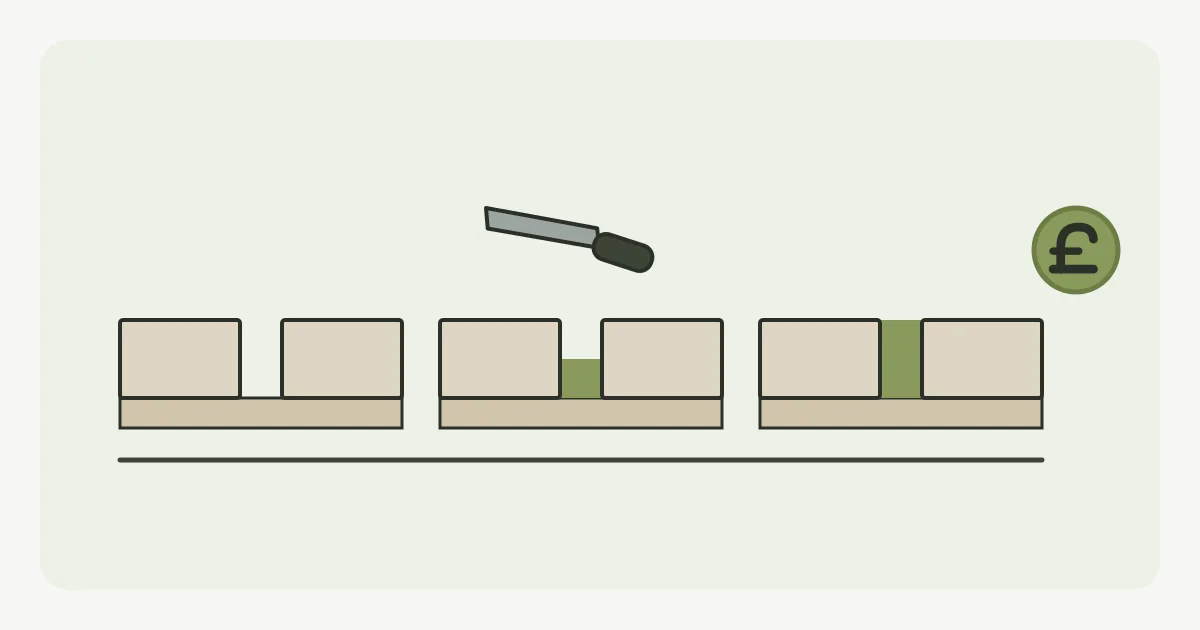
Repointing a patio in the UK typically costs between £300 and £1,200. It's one of the best-value jobs in the trade, because a patio whose joints have failed usually has perfectly sound slabs sitting on a perfectly sound base — the only thing that's gone is the material between them. Renewing that costs a fraction of replacing the patio, and it buys another decade.
Patio repointing cost by area
These are installed prices for patio repointing, covering raking out the old joints, cleaning and refilling.
Typical UK prices. Actual quotes vary by joint width, how hard the old material is to remove and the pointing method used.
| Job size | What's usually involved | Typical cost |
|---|---|---|
| Small area or a few joints | A localised patch where pointing has washed out, or the joints around a few replaced slabs | £300 – £600 |
| Medium patio, full repoint | Every joint across a standard garden patio raked out, cleaned and refilled | £600 – £900 |
| Large patio, full repoint | A larger area, wider or deeper joints, or old mortar that has to be cut out rather than raked | £900 – £1,200+ |
Why raking out is most of the bill
The instinctive assumption is that you're paying for the new pointing. You aren't, mostly. The new material is cheap, and applying it is quick. What takes the time is getting the old material out — every joint, to a consistent depth, without chipping the edges of the slabs either side.
That's slow, physical work, and it's the step that decides whether the job lasts. New pointing laid over a shallow layer of old, loose mortar has nothing to bond to and lifts within a season or two. Rushing the raking-out stage is the single most common reason a repointing job fails early, which is why a quote that looks suspiciously cheap is usually cheap in exactly that place.
It also explains why two patios of the same size can be priced differently. Soft, crumbling mortar comes out with a hand rake. A hard cement-rich mix from the 1980s has to be cut out with a power tool, joint by joint, and that can double the labour.
Mortar or brush-in compound
There are two normal ways to fill the joints again, and they aren't priced the same.
- Traditional mortar pointing is mixed on site and pressed into each joint by hand, then tooled to a neat finish. Materials are cheap; labour is the cost. It suits wider, irregular joints — which is most natural stone patios.
- A brush-in resin or polymeric jointing compound is swept into cleaned, dry joints and left to cure. The material costs considerably more per square metre, but it goes in far faster, tends to be more flexible and so is less prone to cracking, and is commonly used on porcelain and tighter-jointed modern patios.
On a small patio, mortar is usually cheaper overall. On a large one with consistent joints, the labour saved by a brush-in compound can close the gap or reverse it. Either way, the material used should be named on the quote rather than described as just 'repointing'.
Why two similar patios get different quotes
- How hard the old material is to remove — by a distance the biggest variable.
- Joint width and depth. Wide riven-stone joints take more material and more time to finish than narrow porcelain ones.
- The condition of the surface beforehand. Heavy moss, weed growth or ingrained algae means cleaning before anything else happens.
- Whether any slabs need lifting. If a joint has failed because the slab under it is rocking, that's a patio repair as well — see the patio repair cost guide.
- Weather and season. Mortar and most brush-in compounds need dry conditions above a minimum temperature to cure properly, so winter work can mean waiting for a window.
If one quote is well below the others, ask how deep the joints will be raked out and how. Being told 'we'll brush the loose stuff out and point over it' is the answer to avoid — it's the version of this job that looks perfect for a summer and then lifts. Ask for the raking depth and the pointing material to be stated on the quote.
Is repointing enough on its own?
Repointing fixes the joints. It doesn't fix anything underneath them, and it's worth being honest with yourself about which you have before booking. Joints that have failed across an otherwise flat, stable patio are a repointing job. Joints that keep failing in the same spot, or that have gone alongside a slab that rocks or sits low, are telling you something about the bed or the drainage below. Our guide on whether to repair, repoint or replace your patio walks through how to tell, and the signs your patio needs work checklist covers what to look for. For a rough figure, the patio cost calculator will give you a starting point.
Frequently asked questions
How long does patio repointing last?
A properly repointed patio using a good-quality mortar or jointing compound should last ten years or more. Harsh weather, tree roots and heavy use shorten that, and joints on a patio that holds water will always fail sooner than ones that drain freely.
Is repointing cheaper than replacing a patio?
Considerably. A full repoint typically costs £300 to £1,200 against £1,500 to £5,000 for a new patio, so where the slabs and the base are sound it's rarely a close call. The calculation only changes once enough of the paving itself has failed that you'd be pointing around slabs due for replacement anyway.
Can I repoint a patio myself?
On a small patio it's a realistic DIY job, particularly with a brush-in compound. The part people underestimate is raking out — it's slow, hard on the hands and knees, and doing it shallow is what causes the finished job to fail. Budget far more time for removing the old pointing than for putting the new in.
What's the difference between repointing and regrouting a patio?
They're generally the same job by different names. Both describe renewing the material between paving joints, whether that's traditional mortar or a modern brush-in jointing compound.
Ready to talk to a patio repointing specialist?
Get Free Quotes →