
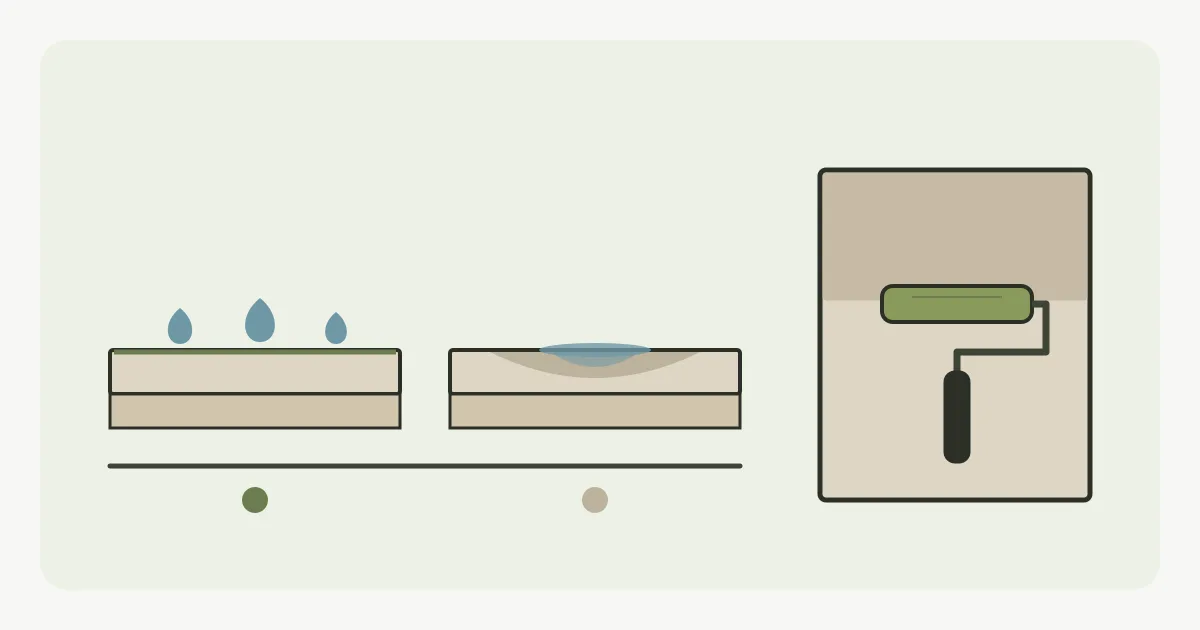
Our two material pages say opposite things about sealing, and both are right. The Indian sandstone page says sandstone is usually sealed. The porcelain page says porcelain never needs it. The difference is porosity. A sealer protects stone by filling or coating the tiny pores that let water, oil and dirt soak in. Sandstone is full of them. Porcelain, fired at very high temperatures, has almost none, so there's nothing for a sealer to do.
Everything else on this page follows from that, plus a couple of trade-offs that are easy to miss until the patio has been sealed and can't easily be unsealed.
Material by material
General guidance. Check your stone supplier's recommendation, and test any sealer on a spare slab or hidden corner first.
| Paving | Seal it? | Why |
|---|---|---|
| Porcelain | No | Non-porous; a sealer can't soak in and may leave a film or smear |
| Indian sandstone | Usually | Porous; sealing helps resist staining, algae and fading, especially on lighter colours |
| Limestone | Often | Porous and sensitive to acidic spills; a sealer buys time to wipe them up |
| Slate | Sometimes | Fairly dense; sealing is mostly for colour and stain resistance rather than protection |
| Granite | Rarely | Dense; some lighter granites are sealed against staining |
| Concrete flags | Optional | Can help with staining and colour; many are left unsealed |
What sealing actually does for sandstone
- Stains. Barbecue fat, red wine, rust from furniture and the brown tannin marks left by leaves soak into unsealed sandstone. On sealed stone they sit on the surface long enough to wipe off.
- Algae and dirt. Sealed stone takes up less water, so it dries faster and gives algae less to work with. It slows regrowth; it doesn't stop it.
- Colour. Lighter sandstones tend to fade and weather to a duller tone over time. Some sealers slow that, and colour-enhancing ones deepen the colour noticeably.
- Cleaning. A sealed surface generally needs gentler cleaning, which matters because aggressive cleaning is what damages sandstone. Our guide to cleaning a patio without damaging it covers that.
The trade-offs
Sealing isn't free of downsides, and these are the ones worth knowing before you commit.
- Grip. Riven sandstone grips well when wet because of its texture. A heavy, film-forming sealer can fill that texture and leave a smoother, glossier surface that's more slippery in the rain. Our sandstone page makes the same point: ask about slip resistance before sealing a patio by the back door or round a pool.
- Appearance. Some sealers darken the stone or give it a 'wet look'. Some people love that; others find their patio no longer looks like the sample they chose. A test patch settles it.
- Peeling and clouding. Film-forming sealers can peel in patches as they wear, and a sealer applied over damp stone can trap moisture and turn cloudy or white. Neither is easy to put right.
- Commitment. Sealers wear and need renewing every few years to keep working, depending on the product and how much traffic the patio gets. A film-forming one usually has to be stripped, not just topped up, once it starts failing.
The main sealer types, impregnating and film-forming, are compared in more detail in the patio cleaners and sealers comparison. As a broad rule, impregnating sealers that soak in and leave the surface looking natural avoid most of the problems above, at the cost of less dramatic colour.
When to seal a new patio
Not straight away. The mortar bed and joints need to cure, and the stone needs to be thoroughly dry, otherwise the sealer can lock moisture or salts into the surface. Many installers wait several weeks after laying, and some prefer to let a new sandstone patio go through a period of weathering first so any efflorescence (white salt bloom) has worked out before it's sealed in. Ask your installer what they recommend, and whether sealing is in the price or a separate visit.
On an existing patio, clean it properly first and let it dry for a few days of good weather. Sealing over dirt, algae or black spot locks it in place.
DIY or professional?
Applying an impregnating sealer to a clean, dry patio is a straightforward DIY job with a roller, brush or low-pressure sprayer. The hard parts are the preparation and the weather window. A professional brings the cleaning kit, knows which products suit which stone, and will usually handle the timing. On a new sandstone patio, the Indian sandstone patio cost guide explains how sealing should appear on the quote.
If you're still deciding, sealing is one of the real practical differences. Sandstone gives you natural variation and needs some looking after; porcelain gives you consistency and needs almost none. The porcelain vs Indian sandstone comparison puts that alongside cost, grip and how each weathers.
Frequently asked questions
Should I seal my Indian sandstone patio?
It's generally recommended. Sandstone is porous, so unsealed stone stains more easily, holds more water and grows algae faster. An impregnating sealer that keeps the natural look is a common choice. Wait until the patio has cured and dried, and test the product on a spare slab first.
Does sealing make a patio slippery?
It can. Heavy film-forming sealers can fill the texture of riven stone and leave a smoother surface that's more slippery when wet. Impregnating sealers that soak in generally change grip far less. If slip resistance matters, ask about it before choosing a product.
Do I need to seal porcelain paving?
No. Porcelain is non-porous, so a sealer has nothing to soak into. Applying one can leave a film or smears on the surface. Clean the joints and the surface as needed and leave it at that.
How often should a patio be resealed?
Every few years is typical, but it depends on the product, the stone and how much use the patio gets. A simple check is to sprinkle water on the surface: if it soaks in and darkens the stone quickly rather than beading, the sealer is wearing out.
Ready to talk to a patio installation specialist?
Get Free Quotes →