
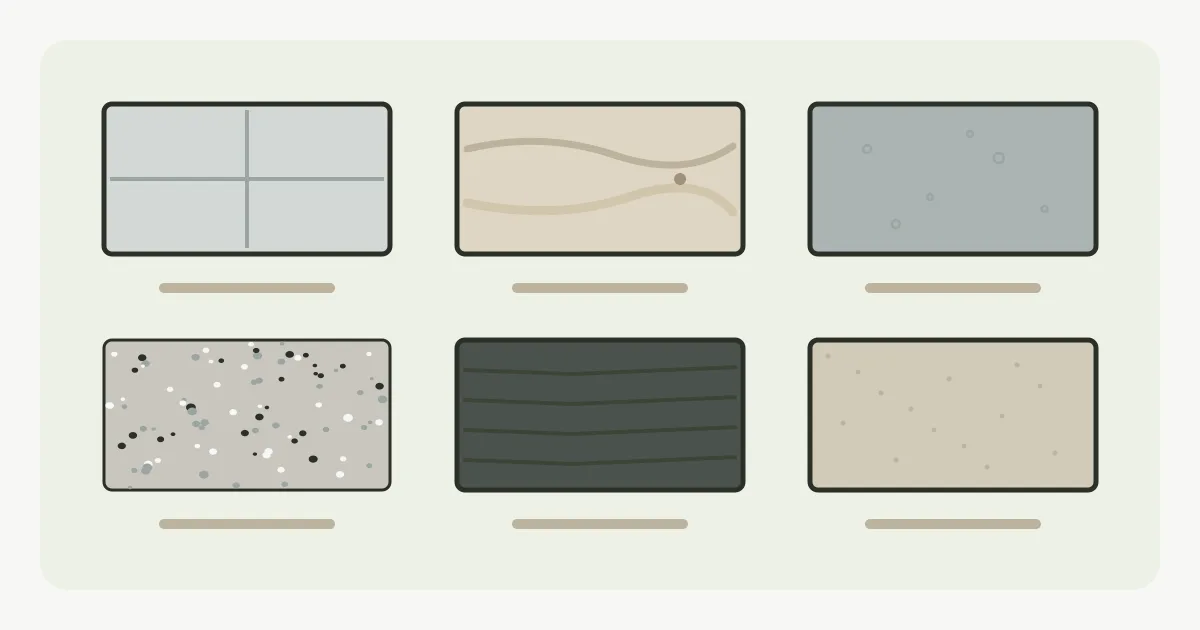
We compare paving by material category, using widely documented properties and our own published price ranges where we have them. We don't name or rank product ranges or suppliers, and nothing here has been lab-tested. Quality varies a great deal within every category, so look at real samples before you decide.
There's no single best patio slab. There's the right one for a particular house, garden, budget and tolerance for upkeep. Most of our pages focus on porcelain and Indian sandstone, because that's where most UK homeowners end up, but four other materials are worth a look before you narrow it down: limestone, granite, slate and concrete.
The six side by side
Price tiers are relative, for supply and lay on a typical garden patio. Where we publish installed figures, they're shown; actual quotes depend on the product, area, access and ground.
| Material | Price tier | Upkeep | Grip when wet | Watch out for |
|---|---|---|---|---|
| Concrete flags | Budget | Moderate; can be sealed | Good on textured finishes | Colour fading on cheaper flags; heavier units |
| Indian sandstone | Mid (roughly £130 – £200 per m² installed) | Higher; usually sealed | Good when riven | Staining, algae, black spot, fading on light colours |
| Limestone | Mid | Moderate; often sealed | Varies; honed finishes can be smooth | Damage from acids, including some cleaners |
| Slate | Mid to upper | Low to moderate | Varies; smooth riven slate can be slippery | Flaking along its layers on poorer grades; gets hot in sun |
| Porcelain | Upper (roughly £165 – £230 per m² installed) | Low; never sealed | Depends on the range's finish | Needs skilled laying; matching later if a range is discontinued |
| Granite | Upper | Low | Good on flamed or textured finishes | Cost; very heavy and hard to cut |
Concrete flags
Concrete is the budget option and has been on British patios for decades. It comes in a huge range of shapes, colours and textures, from plain pressed flags to wet-cast slabs moulded from real riven stone, which look surprisingly convincing for the money. It's durable and easy to replace, since standard sizes are widely stocked.
The weaknesses are mostly cosmetic. Colour on cheaper flags can fade as the surface weathers, it's more porous than porcelain, which means it stains and greens, and it can show white efflorescence when new. Concrete paving is the main subject of Interpave, the UK trade body for precast concrete paving, which publishes guidance on laying and specification.
Indian sandstone
The default natural stone for UK patios: warm colours, natural variation, a riven surface that grips well and a price that sits between concrete and porcelain. It's porous, so it needs sealing and more cleaning than the denser options, and lighter shades fade. The porcelain vs Indian sandstone comparison covers it in depth, and the Indian sandstone patio installation page explains the finishes.
British sandstones, Yorkstone being the best known, are also used for patios, often reclaimed. They're generally more expensive and are usually chosen to match an older property or local stone.
Limestone
Limestone paving is usually smoother and more uniform than sandstone, often in blue-greys, greys and buffs, and is typically supplied sawn or honed for a clean, contemporary look. It suits modern gardens that want natural stone without sandstone's busy variation.
Its weak point is chemistry. Limestone is attacked by acids, so spilt wine, vinegar or citrus can mark it, and acid-based patio cleaners can damage the surface badly. It's commonly sealed for that reason. Honed or very smooth finishes can also be slippery when wet, so a textured finish is the safer choice by a door or on steps.
Granite
Granite is about as hard-wearing as natural paving gets. It's dense and has low porosity, so it resists staining and frost well and needs very little looking after. Outdoor granite is often given a flamed finish, where the surface is heated so it roughens, which gives good grip. Colours are typically speckled greys, silvers, blacks and some warmer tones.
The downsides are cost and weight. Granite is among the more expensive options, and its hardness makes it slower to cut, so a design with lots of cuts or curves costs more to lay.
Slate
Slate gives a dark, sleek, layered look, in charcoal, blue-black, green or rust tones. It's dense and doesn't absorb much water, so it resists staining fairly well. Good slate is very durable.
Poor slate isn't. Lower grades can delaminate, flaking along their natural layers after a few winters of frost, so quality and source matter more with slate than with most materials. Dark slate also gets noticeably hot in strong sun, which matters if children or dogs use the patio barefoot, and smooth riven slate can be slippery when wet.
Porcelain
Porcelain is manufactured, kiln-fired and close to non-porous. It's consistent, stain-resistant, doesn't need sealing and holds its colour well. Outdoor ranges are typically 20mm thick and come in finishes imitating stone, concrete and even timber. It costs more to buy and to lay, because every slab is primed and it's harder to cut. See porcelain patio installation for the options.
Choosing by situation
- Shady, damp garden that goes green: porcelain or granite, which give algae the least to hold on to. Sort out the drainage too.
- Period or rural house: Indian sandstone, or a British sandstone or reclaimed stone to match.
- Modern house, clean lines: porcelain, sawn limestone or slate.
- Tight budget: concrete flags, or a budget sandstone.
- Hot, sunny patio used barefoot: avoid dark slate and very dark porcelain.
- Lowest upkeep: porcelain, then granite.
- Steps, back doors, older users: whichever material you choose, pick a textured finish and check its slip rating where one is published.
What matters as much as the material
A premium slab on a poor base will fail sooner than a budget one laid properly. The sub-base, the bed under each slab, the fall away from the house and the jointing decide how a patio performs far more than the choice between two good materials. Our guide to how a patio is laid covers what to check. For budgeting, the patio installation cost guide explains the other cost drivers, and planning a new patio covers size, position and levels.
Frequently asked questions
What are the best patio slabs?
It depends on the house, the garden and how much upkeep you want. Porcelain is the lowest-maintenance and most consistent; Indian sandstone is the traditional natural choice at a mid price; granite is very durable but expensive; limestone and slate suit contemporary designs; concrete is the budget option.
What is the cheapest type of patio slab?
Concrete paving flags are generally the cheapest, followed by budget grades of Indian sandstone. Porcelain and granite usually sit at the top end, partly because they're more expensive to lay as well as to buy.
Which patio material needs the least maintenance?
Porcelain, which is close to non-porous and never needs sealing, followed by dense natural stones like granite. All patios still need their joints and surface cleaning from time to time.
Is limestone good for a patio?
It can be, particularly for a clean, contemporary look. It's sensitive to acids, though, so it's usually sealed and needs cleaning products that are safe for limestone, and smooth honed finishes can be slippery when wet.
Ready to talk to a patio installation specialist?
Get Free Quotes →