
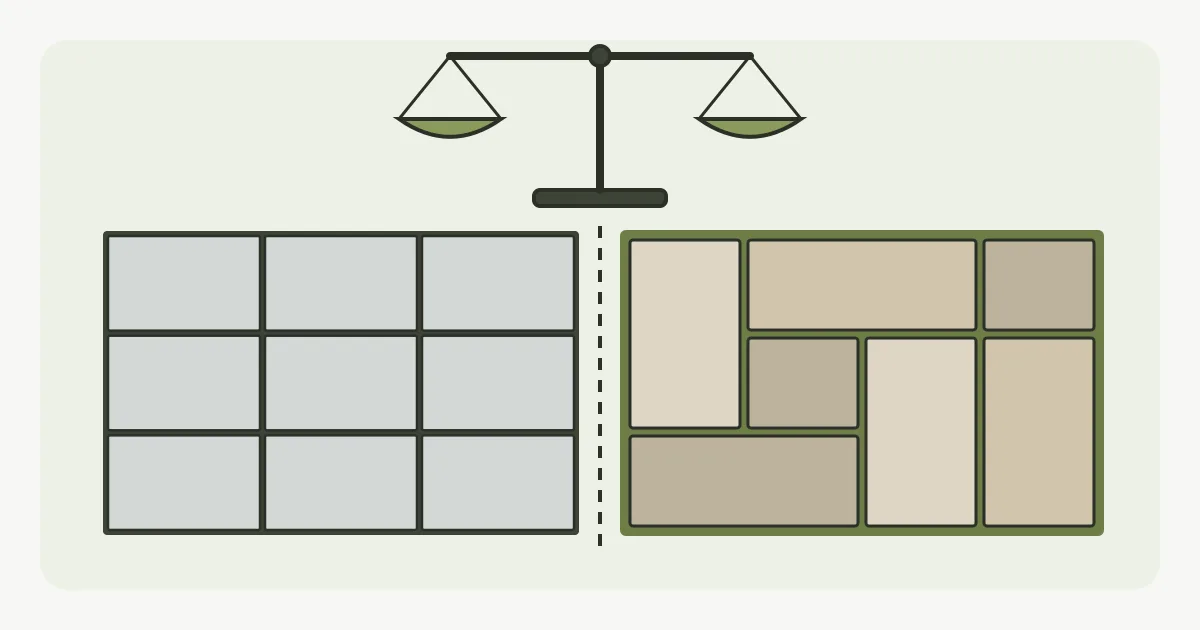
This page compares porcelain and Indian sandstone as material types, using the price ranges published on our own service pages and widely known properties of each. It doesn't rank suppliers or product ranges, and we haven't lab-tested anything. Quality varies a lot within both materials, so treat it as a framework for asking the right questions, not a verdict.
Most people choosing a new patio end up at this question. Indian sandstone has been the standard British patio stone for a generation; porcelain has caught up fast. They're laid on much the same base by the same contractors, and the price ranges overlap. What separates them is how they look, how they behave in a wet British garden over ten or twenty years, and how much looking after each one needs.
At a glance
Installed price ranges are typical UK figures from our cost guides. Actual quotes depend on the specific range, area, access and ground.
| Porcelain | Indian sandstone | |
|---|---|---|
| Typical installed price | Roughly £165 – £230 per m² | Roughly £130 – £200 per m² |
| Typical patio (by size) | £2,500 – £7,000+ | £2,000 – £6,000+ |
| Sealing | Never needed | Usually recommended, and renewed every few years |
| Look | Consistent colour and size; can imitate stone, concrete or timber | Natural variation slab to slab; riven or sawn |
| Staining and algae | Highly resistant | More prone, especially unsealed and in shade |
| Grip when wet | Depends on the surface finish of the range | Riven stone grips well; sawn or heavily sealed is smoother |
| Laying | Primer on every slab; precise, flat base | Bed adjusted for uneven thickness unless calibrated |
| Matching a broken slab later | Easy if the range is still made; hard if discontinued | Natural variation makes a near-match easier to blend |
Cost on the day, and cost over time
On the day, sandstone is usually cheaper. The slabs themselves cost less per square metre than most outdoor porcelain, and porcelain needs a primer on the back of every slab plus more careful cutting, both of which add labour. The porcelain patio cost guide and the Indian sandstone patio cost guide break the figures down.
The gap narrows afterwards. Sandstone wants sealing when it's laid and periodically after that, plus more cleaning. Porcelain needs neither. Over a long enough period, the running costs of sandstone eat into its head start, though it's rarely enough to make porcelain the cheaper option outright.
The overlap is real, though. A budget porcelain can undercut a premium sandstone, and ground conditions, access and the size of the patio often move a quote more than the choice of slab does.
Sealing and everyday upkeep
This is the clearest practical difference. Sandstone is porous: it soaks up water, grease and leaf stains, it's where algae and black spot settle, and lighter colours fade over time. Sealing slows all of that but doesn't stop it, and the sealer itself needs renewing. Porcelain is close to non-porous. Spills wipe off, algae has far less to hold on to, and there's no sealing, ever. Our guide to patio sealing explains why the two materials need opposite advice.
Porcelain isn't maintenance-free, though. Its joints still weather, moss still grows in them, and on a shady patio the surface still goes green, just more slowly and more easily cleaned.
The look
Sandstone is natural rock, so no two slabs match. Colour shifts across a pack, some slabs carry veins or iron spots, and riven sandstone has an uneven, split surface. That's exactly why people choose it, and it suits period houses, cottage gardens and informal planting. It also hides dirt and wear well.
Porcelain is manufactured, so slabs are consistent in size, flatness and colour. It suits modern houses and clean lines, large formats with narrow joints, and 'inside-out' schemes where the patio matches a kitchen floor. Many ranges imitate sandstone, slate or concrete, and the better ones are convincing at a distance, but up close the pattern can repeat.
Grip when wet
Riven sandstone has a naturally textured surface and generally grips well in the rain. Sawn sandstone is smoother, and a heavy sealer can smooth either. With porcelain, grip depends entirely on the finish of the range: outdoor porcelain is normally made with a textured surface for exactly this reason, and manufacturers usually publish a slip rating for it. If the patio is by a back door, has steps or will be used by older relatives, ask to see the rating and compare like with like. A sample slab wetted under a tap tells you a lot too.
How each one ages
Sandstone weathers. Over the years it mellows, picks up some patina and develops the slightly worn look people associate with old stone. Lighter colours fade more than darker ones. Some find that charming; others find their patio no longer looks like the day it was laid.
Porcelain barely changes. The colour is fired in, so it doesn't fade in the same way, and the surface resists wear well. In ten years it should look very much as it did when it went down, which is the point for some people and a drawback for others.
Laying differences that affect the result
- Porcelain must be primed. Mortar won't grip its dense back on its own, so each slab gets a bonding slurry or primer. Skipping it is a known cause of loose slabs. It also needs a full bed and a very true base, because large, flat slabs show any unevenness as lipping at the joints.
- Porcelain is harder to cut. It needs the right diamond blade and patience, which is part of why curved or fiddly layouts cost more in porcelain.
- Hand-cut sandstone varies in thickness, so the installer adjusts the bed under each slab. Calibrated sandstone is ground to a consistent thickness and lays faster.
Our guide to how a patio is laid covers the full build-up, including the bed and the primer, and what to ask for in writing.
Repairs years later
This is the difference almost nobody asks about up front. If a porcelain slab cracks in eight years' time, you need the same range, colour and size to replace it. If the range has been discontinued, a near-match can stand out badly against a uniform surface. Buying a few spare slabs at the start is cheap insurance. With sandstone, the natural variation is forgiving: a slab from a different batch often blends in once it has weathered.
Sourcing
Indian sandstone comes mainly from quarries in Rajasthan, and there have long been concerns about working conditions, including child labour, in parts of the stone supply chain. Many UK suppliers now publish information about how and where their stone is sourced. It's reasonable to ask your installer or supplier about it, and our sandstone page suggests doing exactly that.
Which suits which garden
- Porcelain tends to suit modern houses, shady or damp gardens where algae is a constant battle, people who want minimal upkeep, and designs with large slabs and narrow joints.
- Sandstone tends to suit period and rural properties, informal gardens, tighter budgets, and people who like a surface that changes with age and don't mind sealing it every few years.
If neither feels right, the patio paving materials comparison adds limestone, granite, slate and concrete to the shortlist. When you're ready to price it, compare quotes for porcelain patio installation and Indian sandstone patio installation side by side.
Frequently asked questions
Is porcelain better than Indian sandstone for a patio?
Neither is better across the board. Porcelain is more consistent, more stain-resistant and needs no sealing. Sandstone is usually cheaper to lay, has natural variation and texture, and weathers into an older look. The right choice depends on the house, the garden and how much upkeep you want.
Is porcelain paving more expensive than sandstone?
Usually, yes, on the day: typically around £165 to £230 per square metre installed against £130 to £200 for sandstone. Porcelain's lack of sealing and lower cleaning needs narrow the gap over the years.
Which is less slippery, porcelain or sandstone?
It depends on the finish. Riven sandstone generally grips well when wet. Outdoor porcelain is normally made with a textured surface and comes with a published slip rating, which varies by range. A smooth sawn stone or a heavily sealed surface can be more slippery than either.
Does porcelain paving fade?
Very little. Its colour is fired in during manufacture, so it holds its appearance far better than natural stone, which tends to weather and, in lighter colours, fade over time.
Ready to talk to a porcelain patio installation specialist?
Get Free Quotes →