
For most people the answer is no. A patio laid in the back garden of a house, at or close to the existing ground level, is normally permitted development in England, which means it doesn't need a planning application. That's why every one of our service pages says much the same thing in a sentence or two.
The sentence or two hides a list of exceptions, though, and some of them catch people out after the patio is down. This page goes through them one at a time. It's written mainly about England. Scotland, Wales and Northern Ireland have permitted development rules of their own, covered further down.
Planning rules change, and individual properties can have restrictions you won't see from the street. If anything below might apply to you, the decision rests with your local planning authority, and a quick enquiry before work starts costs far less than a retrospective application after.
The ordinary case: a patio at ground level, behind the house
Replacing a lawn with paving, or swapping an old patio for a new one, at roughly the same level as the garden around it, is the case permitted development is written for. In England the rules for hard surfaces around a house sit in Class F of the General Permitted Development Order. A back-garden patio at ground level falls comfortably within them, whatever it's made of.
Each of the situations below can change that.
If the patio is raised
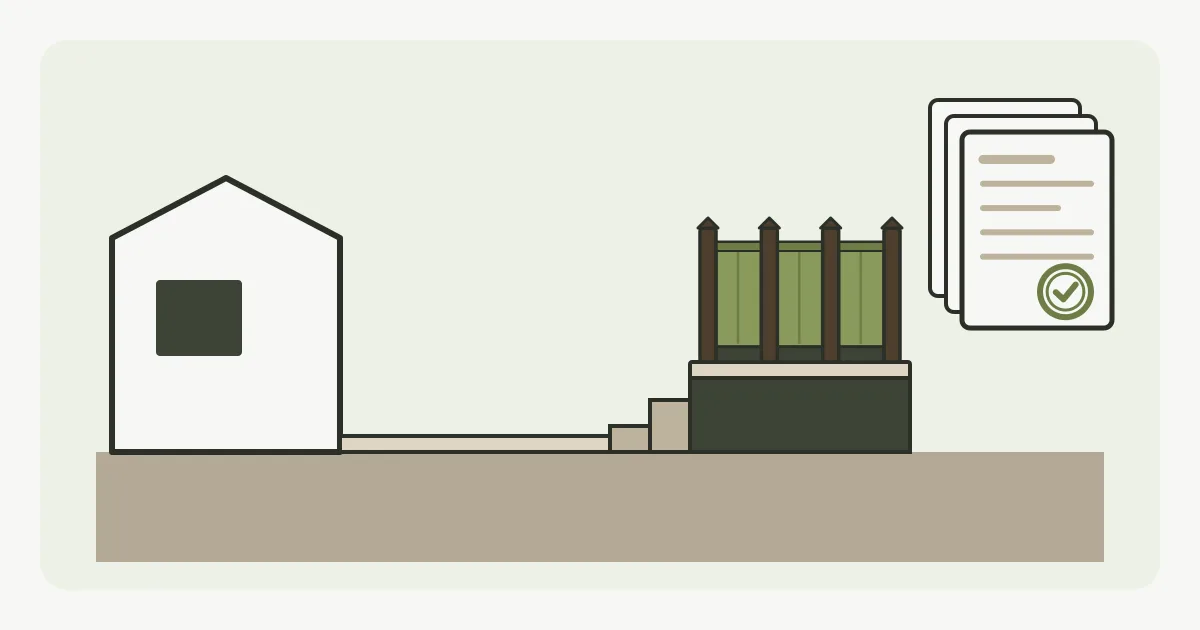
This is the exception that matters most for patios. Permitted development allows hard surfaces, but a patio that's built up above the garden on a sloping site, retained by walls and reached by steps, starts to look like a raised platform, and raised platforms are treated differently. Above a certain height they need permission. The Planning Portal's guidance on decking and raised platforms sets out the limit, and the same thinking applies to a raised paved terrace.
Height also brings privacy into it. A patio that lets you look straight over the fence into a neighbour's garden or windows is the kind of thing that generates complaints, and complaints are what bring a planning officer round. If your garden slopes and the patio will sit well above part of it, check before you build.
If it's in the front garden
Front gardens have their own rule in England, aimed mainly at driveways but written about any hard surface between the front of the house and the road. Above a modest size, new or replacement paving there has to be permeable, or drain to a lawn or border within your own property, otherwise it needs permission. A front patio built in impermeable porcelain or mortar-jointed stone with nowhere for the water to go can fall foul of it. The Planning Portal's paving your front garden page explains the rule, and the government publishes guidance on permeable surfacing for front gardens.
If you live in a flat or maisonette
Householder permitted development rights belong to houses. Flats and maisonettes don't have them in the same way, so a ground-floor flat laying a new patio in its garden may need permission where a house next door wouldn't. If you're a leaseholder, the lease and the freeholder's consent come into it too.
If the property's permitted development rights have been removed
Some houses don't have the normal rights at all. Councils can remove them with an Article 4 direction, which is common in conservation areas, and planning permission for newer estates sometimes includes a condition taking them away. Neither shows up when you look at the house. Your local authority can tell you, and a solicitor's search will have flagged it if you bought recently.
If the building is listed or in a conservation area
For a listed building, work within its grounds that affects its character or setting can need listed building consent, which is separate from planning permission and has no permitted development equivalent. A new patio against a listed house is worth checking, particularly if it means changing the ground level at the wall or removing historic paving. The Planning Portal has guidance on listed buildings. Conservation areas don't usually stop a back-garden patio, but they're where Article 4 directions are most common.
Boundaries, neighbours and the Party Wall Act
A patio built against a shared garden wall, or one that involves digging close to a neighbour's house, can bring the Party Wall etc. Act 1996 into play. That isn't planning permission, but it can mean giving your neighbour formal notice before work starts. The government's party wall guidance explains when it applies. Raising the ground against a neighbour's fence or wall is also worth discussing with them first: soil and paving piled against a fence that was never meant to retain it will rot or push it over, and that becomes a dispute.
Trees and covenants
- Protected trees. If a tree in or next to your garden has a Tree Preservation Order, or you're in a conservation area, digging out for a patio within its root area can need the council's consent. Excavation is one of the commonest ways trees get damaged without anyone touching the trunk.
- Restrictive covenants. Some deeds, particularly on newer estates, restrict what you can build or change in the garden. They're a private legal matter rather than a planning one, but they're enforceable.
Building Regulations and drainage
A garden patio doesn't normally need Building Regulations approval in its own right. Two things near the house still matter, though. First, the paving should finish at least 150mm below the damp-proof course and mustn't cover any air bricks that ventilate a suspended floor. Second, where new drainage goes in near the building or connects to existing drains, Approved Document H (drainage and waste disposal) can apply. A competent patio drainage installer will know when it does.
Whatever the rules, surface water from the patio mustn't be directed onto a neighbour's land or the public highway. If you're unsure where yours will go, our guide on water pooling on a patio covers the common fixes.
Scotland, Wales and Northern Ireland
The English position above doesn't automatically apply elsewhere in the UK. Each nation has its own permitted development order and its own guidance, and the details on hard surfaces, front gardens and raised platforms differ. For a straightforward back-garden patio at ground level the answer is often the same, but don't assume it. Start with the Welsh Government's planning permission pages, mygov.scot for Scotland, or the Department for Infrastructure's planning pages for Northern Ireland, and confirm with your local council.
A quick summary
England. A guide to when to check, not a substitute for asking your local planning authority.
| Situation | Planning permission usually needed? | Worth checking with |
|---|---|---|
| Back-garden patio at ground level, on a house | No | Nobody, unless something below applies |
| Raised patio or terrace on a sloping garden | Possibly, depending on height | Local planning authority |
| Front-garden paving, not permeable and no soakaway | Possibly, above a modest area | Planning Portal guidance; local authority |
| Flat or maisonette garden | Often | Local authority; freeholder if leasehold |
| House with an Article 4 direction or PD removed | Often | Local authority |
| Listed building | Listed building consent may be needed | Local authority conservation officer |
| Next to a neighbour's wall or house | Not planning, but the Party Wall Act may apply | Neighbour; party wall surveyor |
| Near a protected tree | Consent for works affecting the tree | Local authority tree officer |
If the patio's already down and you're not sure it was allowed, a Lawful Development Certificate (in England and Wales) is the formal way to confirm it. For a new one, our guide to planning a new patio covers the levels and position to settle at the same time, and the patio installation cost guide covers what it's likely to cost.
Frequently asked questions
Do I need planning permission to replace my patio?
Usually not, if you're replacing a back-garden patio on a house with a new one at roughly the same level. The exceptions are the same as for a new patio: raising it significantly, front gardens with impermeable paving, flats, listed buildings and houses whose permitted development rights have been removed.
Does a raised patio need planning permission?
It can. A patio built up above the garden can be treated as a raised platform, and above a certain height that needs permission in England. Check the Planning Portal's guidance on decking and raised platforms, or ask your local planning authority, before building one.
Do I need Building Regulations approval for a patio?
Not normally for the patio itself. New drainage near the house or connecting to existing drains can fall under Building Regulations Part H, and the paving should stay at least 150mm below the damp-proof course without covering air bricks.
Are the rules the same in Scotland, Wales and Northern Ireland?
No. Each nation sets its own permitted development rules and guidance. A simple ground-level back-garden patio often doesn't need permission in any of them, but the details differ, so check with your own council.
Ready to talk to a patio installation specialist?
Get Free Quotes →